
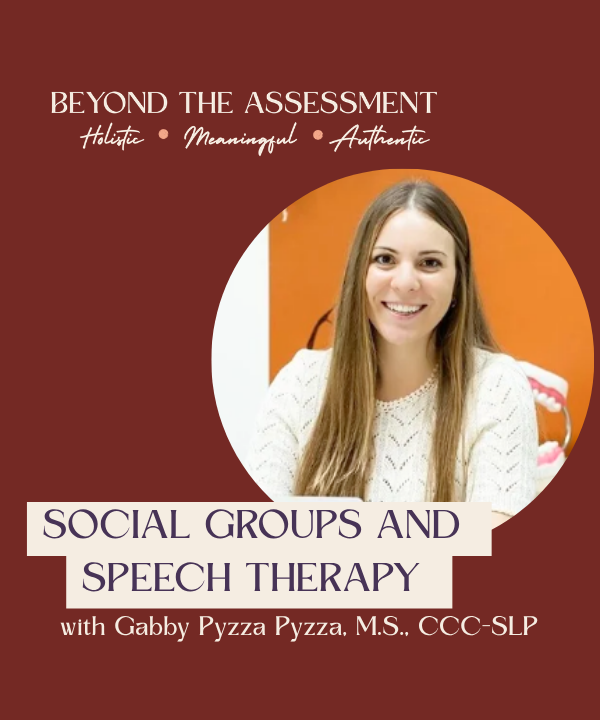


Guest: Gabby Pyzza, Speech-Language Pathologist, Pyzza Speech Therapy (pyzzaspeechtherapy.com)
Your kid can talk for twenty minutes straight about dinosaurs, Fortnite, Anime, Minecraft, or whatever their current obsession is. It’s adorable — until you notice they never ask their friend a single question back. Or the teacher mentions, again, that recess is “tricky” for them. Or a birthday party invite that used to come every year just… doesn’t anymore.
You’ve probably told yourself it’s just a phase, or that they’ll pick it up from being around other kids. Here’s the hard truth: sometimes that’s exactly right. And sometimes it’s a specific, learnable skill gap called pragmatic language — and the earlier you catch it, the easier it is to close.
I sat down with Gabby Pyzza, a speech-language pathologist with a decade of practice, to talk through what social communication actually is, how to tell if your child needs support, and — because it comes up in nearly every intake call — what to do about those tricky R sounds and lisps too.

What “social communication” actually means
Gabby put it simply: pragmatic language is how we interact with other people — not just what we say, but how we read facial expressions, body language, and the back-and-forth rhythm of a real conversation. For a lot of neurodivergent kids, this isn’t something that develops automatically just by being around peers. It has to be taught directly.
A few signs worth paying attention to:
- Your child can talk at length about their favorite topic but has a hard time steering the conversation back to what the other person is interested in
- Friendships and playdates are consistently harder than they should be for their age
- A teacher mentions, more than once, that recess or group work is a struggle
- The gap between them and their peers socially seems to be growing, not closing
Not all “social groups” are the same
One of the most useful things Gabby shared: a lot of parents sign their kid up for a “social skills group” expecting real skill-building, and end up with something closer to a supervised playdate. Both have value — but they solve different problems.
- Play-based groups are great for social opportunities — practice being around peers in a low-pressure setting.
- Speech-therapist-led groups teach the actual mechanics — how to start a conversation, ask a follow-up question, read the room — through direct, structured instruction.
A red flag to watch for: if you genuinely don’t know what skills your child is working on in their group, or it feels more like an activity than instruction, that’s worth a second look. Gabby’s own groups are intentionally age-banded (11–13, 14–17, and 18+) and run in structured 8-week sessions — because a 7-year-old and a 17-year-old simply aren’t learning the same things, or in the same way.
And then there’s the R sound (and lisps)
We couldn’t talk speech without touching on articulation — specifically R sounds and lisps, which Gabby called out as the two trickiest to self-correct. The advice here was clear: don’t wait for “they’ll grow out of it.” By the time a child is 8 or 9, they’ve had years of practice saying the sound the “wrong” way, which makes it more habitual and harder to retrain.
If you’re noticing it — or worse, your child is starting to notice it and feeling embarrassed — an evaluation as early as age 5 or 6 isn’t too soon. One detail worth knowing: there’s often a stigma shift around 4th or 5th grade, where getting pulled out of class for school speech services starts to feel uncool in a way it didn’t in kindergarten. Getting ahead of it earlier — or opting for private support instead of an in-school pullout — can spare a kid that awkward stretch entirely.
What about ESA funds?
If your family uses an Empowerment Scholarship Account, speech therapy is a service many families are already using ESA funds for — either through the ESA debit card or a reimbursement process, depending on your provider. It’s one more piece of the puzzle worth knowing about as you’re weighing options between school-based services and private support.
Where to start
If any of this sounds familiar, you don’t have to figure out on your own whether it’s a normal developmental stretch or something worth a closer look. That’s exactly what a short conversation is for.
[Schedule your free 15-minute consultation →]
And if speech and social communication specifically is the focus, Gabby’s a wonderful local resource — find her at pyzzaspeechtherapy.com or on Instagram/Facebook @PyzzaSpeechTherapy.





+ show Comments
- Hide Comments
add a comment